2026 FIFA World Cup Opening Ceremony
The biggest tournament in football history opens at the most historic stadium in the sport. Estadio Azteca in Mexico City hosts the curtain-raiser on Thursday 11 June 2026, with Shakira, Burna Boy, Mana, Alejandro Fernandez and an A-list lineup of Mexican and global artists performing across a 90-minute spectacle directed by Balich Wonder Studio. The official tournament song "Dai Dai" by Shakira and Burna Boy headlines, the ceremony's creative theme draws on the Mexican folk art of papel picado, and the night closes with Mexico vs South Africa kicking off the most expansive World Cup in history (48 nations, 12 groups, 104 matches across three host countries).
Performers at the opening ceremony
FIFA confirmed a lineup that blends Mexican musical icons with global stars representing the three continental confederations contributing teams to the 2026 World Cup. The mix mirrors the tournament's expanded 48-team format and the FIFA brief to lean into Mexico's cultural identity while acknowledging the global footprint.
 Shakira
 Burna Boy
 ManaAlejandro FernandezBelindaLila DownsLos Angeles Azules
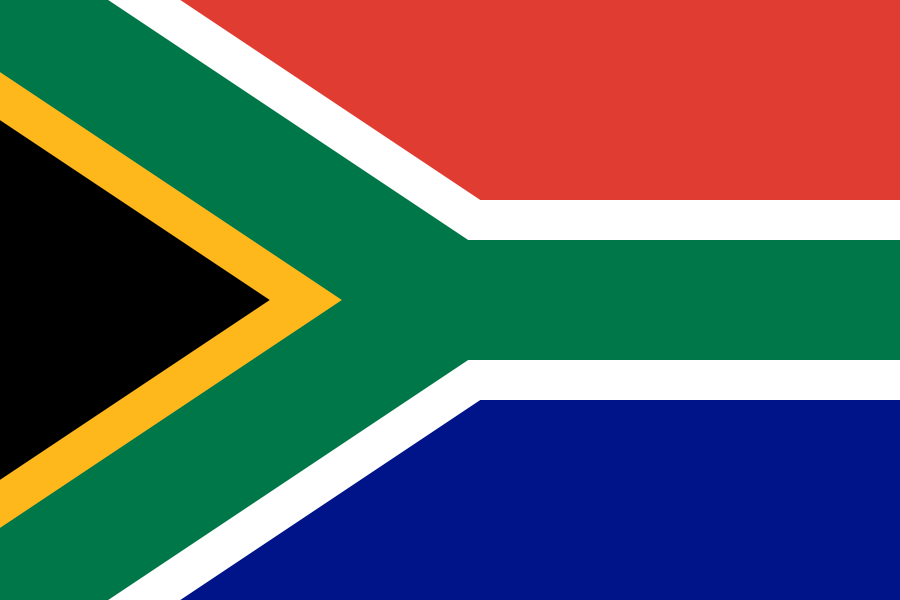 TylaJ Balvin
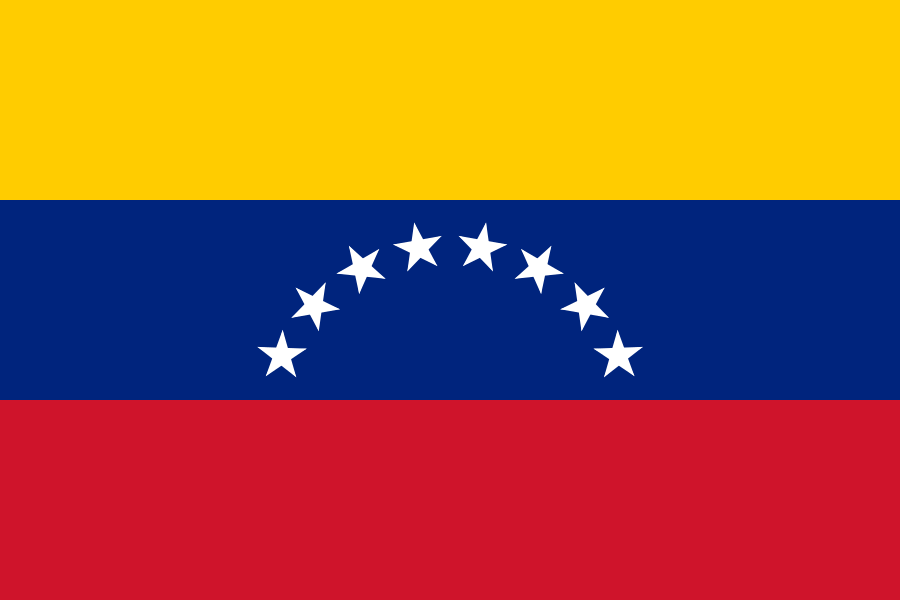 Danny Ocean
The official tournament song: "Dai Dai"
The 2026 FIFA World Cup's official song is "Dai Dai" by Shakira and Burna Boy, released globally on 14 May 2026. The title is a colloquial Spanish phrase meaning roughly "let's go" or "do it", chosen for its punchy, percussive cadence that translates across language barriers and works for crowd chants.
The track blends Shakira's signature Latin-pop melodic style with Burna Boy's Afrobeats production. The chorus interpolates Mexican brass elements (mariachi trumpets layered over electronic percussion) and Burna Boy contributes a sung-rap verse in English that references football folklore: "the ball is alive, the world is wide, dai dai." It is the first time two artists from different continents have collaborated on a FIFA tournament song since Shakira and Freshlyground partnered on "Waka Waka" for the 2010 South Africa World Cup.
The song debuted at number one on Spotify's Global Top 50 within 48 hours of release, recording over 80 million streams in its first week. It will be performed live during the opening ceremony, with reports indicating Shakira and Burna Boy will share the stage for a co-performance lasting roughly six minutes, the centerpiece of the ceremony's musical programming.
Burna Boy's inclusion is symbolically important. The 2026 World Cup features more African nations than any previous tournament (nine teams after CAF's expanded qualification quota), and the songwriter and producer credits on "Dai Dai" include three Nigerian-based collaborators alongside Shakira's longtime production team. The result is the most explicitly cross-continental World Cup song ever commissioned by FIFA.
The creative theme: papel picado
The Mexican ceremony's creative direction is anchored in papel picado, the traditional Mexican folk art of intricately cut tissue paper used for celebrations, religious festivals and Day of the Dead altars. Balich Wonder Studio, the Italian production company behind opening ceremonies at the 2010 Winter Olympics and Expo 2020 Dubai, leads the artistic direction.
Balich's reimagining of the FIFA World Cup Trophy through the papel picado lens is the visual centerpiece. The trophy form is recreated as a 30-meter installation suspended above the centre circle, with cut-paper geometric patterns that shift as choreographed lighting passes through them. The effect is a constantly evolving silhouette that combines the trophy's iconic golden contours with the layered cut-paper aesthetic of Oaxacan craft villages.
Large-scale stadium choreography weaves colour, pattern and indigenous design across the Azteca pitch. Roughly 800 dancers, many drawn from Mexico's traditional folk ensemble Ballet Folklorico de Mexico, perform sequences referencing Aztec mythology, Mexican Revolution imagery and modern Mexico City street culture. The choreography moves chronologically through Mexican cultural history, ending with a contemporary mass formation that incorporates the country's diasporas in the host nations.
The choice of papel picado as the unifying theme reflects FIFA's explicit instruction to lean into Mexican cultural identity rather than producing a generic ceremony. The Italian production team consulted with cultural advisors from Oaxaca, Puebla and Mexico City throughout 2025 and 2026 to ensure the design vocabulary is authentic rather than appropriated. Lila Downs's musical contribution during the segment is directly informed by these consultations.
Estadio Azteca: the only three-World Cup stadium in history

Estadio Azteca opened in 1966 and immediately became the spiritual home of Mexican football. Its 2026 World Cup configuration capacity is 87,500, and a $150 million renovation completed in early 2026 added new VIP suites, an expanded press box, modernised pitch drainage, LED lighting and an enlarged broadcast plaza for the FIFA production unit.
The Azteca's place in football history is unmatched. It hosted the 1970 World Cup Final (Brazil 4-1 Italy, the tournament where Pele cemented his status as the greatest player ever), and the 1986 World Cup Final (Argentina 3-2 West Germany, the tournament that produced Diego Maradona's "Hand of God" handball goal and his "Goal of the Century" against England, both in the same quarter-final match). With the 2026 opening match, the Azteca becomes the only stadium in human history to host matches at three different FIFA World Cups.
Beyond the two final matches, the Azteca has staged hundreds of iconic moments: Mexico's national team home matches across six decades, Club America versus Chivas (the country's most heated club rivalry), the 1986 World Cup quarter-final between Argentina and England, and the 1968 Mexico City Olympics football final. Its altitude (2,240 meters above sea level) has historically created a competitive edge for Mexico at home and a logistical headache for visiting teams unaccustomed to the thinner air.
For the 2026 tournament, the Azteca hosts five matches in total: the opening match (Mexico vs South Africa), the Uzbekistan vs Colombia Group K fixture, a Round of 32 match and a Round of 16 match plus another group game. The venue's selection as the opening match host was confirmed by FIFA in late 2024 and the renovation programme proceeded on time despite supply chain disruptions affecting other venues.
Full schedule for 11 June 2026
The opening day combines ceremonial pageantry with the tournament's first competitive match. All times listed in Mexico City local (CDT). For ET add 1 hour; for CEST add 7 hours.
How to watch the opening ceremony
The ceremony will be broadcast globally and streamed free by FIFA. Most national broadcasters carry the full ceremony plus the opening match that immediately follows.
- Global free stream: FIFA+ (fifa.com) carries the full ceremony and opening match worldwide, no subscription required.
- United States: Fox (English) and Telemundo (Spanish) hold US broadcast rights for the entire tournament and opening ceremony.
- United Kingdom: BBC and ITV split UK World Cup broadcast rights. Both carry the opening ceremony in their full pre-match programming.
- Canada: CBC (English) and TSN/RDS (specialist sports channels) cover the ceremony and tournament.
- Mexico: Televisa, TV Azteca and ViX (streaming) hold local rights with extensive ceremony coverage in Spanish.
- Africa: SuperSport carries the ceremony across sub-Saharan Africa; SABC in South Africa covers the day with extra context given South Africa's opening-match status.
- Europe: Most major European broadcasters (TF1 in France, ARD in Germany, RAI in Italy, TVE in Spain, NRK in Norway) air the ceremony as part of their tournament packages.
Opening ceremonies through World Cup history
FIFA's opening ceremonies have evolved from simple military-style processions in the early decades to the elaborate cultural showcases of the modern era. A quick survey of the most memorable:
1986, Mexico (Azteca's previous opening match): Mexico's last World Cup opening ceremony at the same venue was a relatively modest affair by modern standards. The ceremony lasted under 45 minutes and featured Mexican folk dance and military band performances. Diego Maradona himself led the Argentina team onto the pitch later that tournament, including the historic quarter-final at the Azteca where his "Hand of God" and "Goal of the Century" were both scored.
1994, USA: The first US-hosted World Cup opening ceremony at Soldier Field, Chicago, featured Diana Ross attempting (and missing) a ceremonial penalty kick that became one of the most replayed moments in opening-ceremony history. The miss was actually staged but executed imperfectly.
2010, South Africa: The Johannesburg ceremony at Soccer City featured Shakira's "Waka Waka" performance, which became one of the most commercially successful World Cup songs in history. The use of vuvuzelas during the ceremony hinted at the soundtrack that would define the entire tournament.
2014, Brazil: Sao Paulo's Arena Corinthians ceremony featured Pitbull, Jennifer Lopez and Brazilian singer Claudia Leitte performing "We Are One". The ceremony was deliberately compressed (just 25 minutes) to focus attention on the football, a creative direction that FIFA has not repeated in 2026.
2018, Russia: The Luzhniki Stadium ceremony in Moscow featured Robbie Williams, Brazilian football legend Ronaldo and Russian soprano Aida Garifullina. Robbie Williams gave a one-fingered gesture to the live broadcast camera that briefly dominated tournament coverage.
2022, Qatar: The Al Bayt Stadium ceremony was the first to feature South Korean superstar Jung Kook (of BTS) performing the official song "Dreamers" alongside Qatari singer Fahad Al Kubaisi. Morgan Freeman's narration of the ceremony's central message of inclusivity drew significant global attention.
The 2026 ceremony at Estadio Azteca aims to combine the cultural depth of the 2022 ceremony with the musical scale of 2010 South Africa, deliberately positioning Mexico's hosting role as the opening of a tournament that will run for 38 days across three nations and 16 venues.
Why this opening ceremony matters
The 2026 FIFA World Cup is the first tournament with 48 teams, the first hosted across three nations (USA, Canada, Mexico) and the most-attended World Cup in history with projected aggregate attendance over 5.5 million across all 104 matches. The opening ceremony at Estadio Azteca therefore carries unusual significance beyond the football itself.
It also marks Mexico's third World Cup as host (1970, 1986, 2026), a record matched only by Italy and France. The cultural and political messaging of the ceremony positions Mexico as the historical anchor of the tournament, despite the United States hosting the majority of matches (78 of 104) and the final. Mexico City's selection over US opening venues like SoFi Stadium in Los Angeles or MetLife in New Jersey reflects FIFA's recognition of Mexican football culture's depth.
For South Africa, opening the tournament against Mexico is the highest-profile match in the country's footballing history beyond the 2010 World Cup they hosted. Bafana Bafana coach Hugo Broos has framed the match as the chance to establish themselves as a serious knockout-round contender; the global audience for the opening match typically reaches over a billion viewers, the largest single-match audience of the tournament outside the final.
The performers selected also send a message about the tournament's cultural footprint. The mix of Mexican legends (Mana, Alejandro Fernandez), African headline talent (Tyla, Burna Boy), Latin global stars (Shakira, J Balvin, Danny Ocean) and indigenous Mexican voices (Lila Downs) deliberately spans the continents and traditions that the expanded 48-team format will showcase. The Italian production team's role highlights the global infrastructure that FIFA tournaments now require.
FAQ
Thursday 11 June 2026 at 11:30 AM local Mexico City time (12:30 PM ET, 18:30 CEST). It runs for approximately 90 minutes before the opening match (Mexico vs South Africa) kicks off at 1:00 PM local time.
Estadio Azteca in Mexico City, capacity 87,500. It becomes the only stadium in human history to host matches at three different FIFA World Cups (1970, 1986, 2026) and underwent a $150 million renovation for the 2026 tournament.
Shakira, Burna Boy, Mana, Alejandro Fernandez, Belinda, Lila Downs, Los Angeles Azules, Tyla (South Africa), J Balvin (Colombia) and Danny Ocean (Venezuela). The lineup blends Mexican icons with global stars from across the football world.
"Dai Dai" by Shakira and Burna Boy, released on 14 May 2026. It will be performed live during the opening ceremony at Estadio Azteca.
Papel picado, the traditional Mexican cut-paper folk art that symbolises celebration, craftsmanship and community. Production studio Balich Wonder Studio reimagines the FIFA World Cup Trophy through this artistic lens, with large-scale stadium choreography incorporating colour, pattern and indigenous design.
FIFA+ streams the ceremony free globally. Regional broadcast partners include Fox and Telemundo in the US, BBC and ITV in the UK, CBC and TSN in Canada, Televisa and TV Azteca in Mexico. Most national broadcasters carry the full ceremony plus the opening match that follows.
It is the only stadium in history to host two World Cup finals (1970 and 1986). Pele's signature performance in 1970 and Maradona's "Hand of God" plus "Goal of the Century" in 1986 both happened here. The 2026 opening match makes it the only stadium ever to host matches at three different World Cups.
Get every 2026 World Cup match preview
BetBot covers every one of the 104 matches at the 2026 World Cup. Free daily tips, anytime goalscorer picks, in-depth match previews and live alerts. Built for the tournament.
All match previews →